


For decades, operating heavy machinery depended almost entirely on the operator’s experience, eyesig...
AI in the Operator Cab: How Heavy Equipment Is Becoming Smarter
Nov 12 2026
By

For decades, operating heavy machinery depended almost entirely on the operator’s experience, eyesight, judgement, and ability to respond quickly. Those skills remain essential, but the modern equipment cab is changing.
Cameras, sensors, GPS receivers, radar, intelligent displays, automated controls, and machine-learning systems are increasingly helping operators make faster and more accurate decisions. Rather than replacing operators, these technologies act as digital assistants, supporting everything from grading and paving to hauling, lifting, and working at height.
The result is a new generation of heavy equipment that is easier to operate consistently, safer around workers, and better connected to the wider construction site.
What Does AI in Heavy Equipment Actually Mean?
Not every smart heavy machine is fully autonomous. In construction equipment, intelligence generally develops across several levels.
The first level includes warning systems, payload monitoring, cameras, and automated machine functions. More advanced systems can control parts of the working cycle, such as adjusting a bulldozer blade or maintaining a paving level. At the highest level, machines may complete repetitive haulage or earthmoving tasks with limited direct input.
Learn more about how AI will impact modern construction through our previous blog.
Caterpillar describes operator-assist technology as the foundation of equipment autonomy. Such systems can automate individual functions, including adjusting blade lift while grading. Its newer autonomy platforms combine AI, computer vision, machine learning, edge computing, radar, LiDAR, GPS, and cameras to process changing site conditions in real time.
This development is part of a wider shift towards Physical AI, where heavy machines use real-world data from cameras, sensors, terrain, weather, and operator inputs to understand their surroundings and perform physical tasks more intelligently.
In practical terms, the operator is still responsible for the machine, but the equipment helps reduce guesswork.

Smarter Earthmoving and Grading
A modern Caterpillar bulldozer can use 2D or 3D grade-control systems to automatically adjust blade height against a digital design. Caterpillar reports that these technologies can improve grading productivity by up to 50%; in one example, a task requiring 10 passes could be completed in around six.
By reducing passes, grade checks, overcutting, and rework, the technology can save fuel and help operators of different experience levels achieve more consistent results. Operator judgement is still essential for managing traction, blade loading, and changing ground conditions.
Intelligent Hauling and Dumping
Smart technology is also becoming increasingly important inside the **articulated dump truck**.
New-generation Volvo articulated haulers include in-cab displays for machine status, camera settings, operating information, and other controls. Selected models also provide hill assist, downhill speed control, cruise control, load-and-dump braking, and a dump-support system that warns the operator about excessive trailer side inclination before unloading.
This matters because tipping an articulated hauler on uneven or soft ground can create serious stability risks. Sensors cannot make an unsafe dumping area suitable, but they can give the operator clearer information before the body is raised.
At a fleet level, intelligent haulage systems can also monitor cycle times, payloads, idling, fuel use, travel routes, and queueing. Contractors searching for a dump truck for rent can therefore look beyond basic payload capacity and consider the machine’s safety aids, telematics, and operator-support features.
For companies evaluating a dump truck for sale, smarter controls may improve consistency across different operators and help managers identify inefficient site layouts or operating habits.
Autonomous haulage is already proven in large mines, and similar technology is beginning to move into quarry-scale operations. Komatsu’s Smart Quarry Autonomous system, for example, is designed to automate selected quarry haul trucks without requiring the same infrastructure as major mining installations.

AI-Assisted Asphalt Paving
Producing a smooth road surface requires close control over material flow, screed settings, paving speed, temperature, and coordination with trucks.
Modern asphalt paver operating systems increasingly bring these functions together on one digital interface. Dynapac’s Pave OS, for example, provides automated features and customizable controls intended to simplify the paving process. Its available functions include systems that store machine settings, support relocation between paving sections, and improve communication between the paver and material-delivery vehicles.
This reduces the number of separate adjustments the operator must make during a shift. When settings are stored and repeated accurately, crews can restart work more efficiently after moving around obstacles, junctions, or access points.
Intelligent paving still depends on correct mix design, delivery timing, screed setup, and compaction. However, digital assistance helps the operator maintain a more stable process and react sooner when conditions begin to change.

Safer Work at Height
Smart safety systems are also entering the boom lift platform.
In 2025, Sinoboom introduced a collision-avoidance system using ultrasonic sensors and radar around the platform. The system can warn the operator, automatically reduce movement speed, and stop the machine when a collision becomes imminent. It is designed to continue detecting obstacles in conditions such as dust, fog, darkness, or limited visibility.
This technology can be especially useful inside warehouses, industrial facilities, steel structures, and congested construction areas. Operators must still inspect the work zone and follow safe operating procedures, but proximity detection provides another layer of protection.
Connected platforms can also transmit utilization data, fault codes, maintenance information, and machine location to fleet managers. Sinoboom’s i-Link platform, launched in 2026, combines connectivity, remote diagnostics, fleet information, and AI-supported management tools.

Smarter Lifting and Crane Control
Lifting operations require precise coordination between operators, riggers, signalers, and supervisors. Intelligent crane systems are now helping operators control load movement more smoothly.
Liebherr’s recent crane-assistance systems include sway control, semi-automated hook positioning, stored travel routes, and systems that help guide the hook towards a load. Its Positioning Pilot can move between stored hook locations while coordinating several crane drives and reducing load sway.
These developments are relevant whether a contractor needs a crane for rent for a temporary project or is comparing a crane for sale for long-term fleet use. Load monitoring, cameras, anti-sway assistance, telematics, and operator visibility can be as important as lifting capacity and boom length.
They do not replace lift plans, certified operators, or proper ground preparation. Instead, they help the operator execute the approved lift more precisely.

The Operator Is Still at the Centre
The smartest construction machine is only effective when its systems are understood and used correctly.
Operators need training not only in traditional machine control, but also in interpreting alerts, using digital designs, checking sensor limitations, and knowing when automated features should be disengaged. A dirty camera, damaged sensor, incorrect calibration, or outdated site model can still lead to poor decisions.
Operator comfort is just as important as smart technology. Modern Kobelco excavator cabins and the redesigned Kobelco CKS1000 crawler crane cabin offer improved visibility, ergonomic controls, reduced noise, climate control, and more spacious layouts to help operators stay focused during long, precise working shifts.
The future operator may spend less time making repetitive corrections and more time managing productivity, safety, and machine information.

Choose Smarter Equipment with Al Marwan
Al Marwan provides a wide range of heavy equipment for sale and a large fleet of heavy machinery rentals, including articulated dump trucks, asphalt pavers, bulldozers, boom lifts, cranes, and dump trucks.
Whether your priority is lifting capacity, intelligent safety features, operator comfort, telematics, or reliable site performance, our team can help you select equipment suited to your project conditions and operating requirements.
Explore Al Marwan’s equipment fleet and request a quotation for your next construction, infrastructure, industrial, or earthmoving project.
LEARN FROM OUR INDUSTRY EXPERTS
Latest news & updates
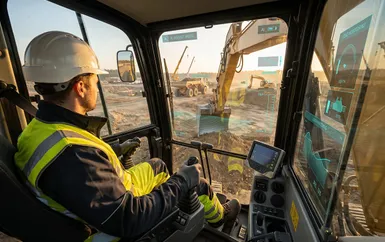
AI in the Operator Cab: How Heavy Equipment Is Becoming Smarter

Inside Aramco Stadium: What Powers This 47,000-Seat Arena?
Rising dynamically along the Arabian Gulf in Al Khobar, Saudi Arabia, the Aramco Stadium is rap...

Sharjah Announces New Women-Only Tower in Kalba as Construction Projects Expand
Sharjah has announced another landmark development in Kalba, with a new women-only observation tower...
History Time: How Caterpillar Got Its Name?
When you visit an Al Marwan site, you’ll see massive machines bearing one of the most iconic names i...
Forklift Mast Height and Mast Types Explained
A forklift may have enough lifting capacity for a load, but that does not necessarily mean it can pl...
