


Rising dynamically along the Arabian Gulf in Al Khobar, Saudi Arabia, the Aramco Stadium is rap...
Inside Aramco Stadium: What Powers This 47,000-Seat Arena?
Nov 10 2026
By

Rising dynamically along the Arabian Gulf in Al Khobar, Saudi Arabia, the Aramco Stadium is rapidly emerging as one of the most technologically advanced athletic arenas in the world. Designed by global architectural firm Populous and owned by ROSHN Group, this landmark venue covers a vast 800,000-square-meter master plan.
With an official capacity of 47,000 seats for tournament matches and expandable up to 55,000 for international entertainment events, the venue is purpose-built to meet rigorous FIFA standards. It will serve as a premier host stadium for the upcoming 2027 AFC Asian Cup, and stage matches through the knockout stages for the FIFA World Cup 2034.

Behind its stunning maritime-inspired architecture lies a relentless heavy engineering and earthmoving operation. Transforming master drawings into structural steel and concrete requires heavy machinery fleets operating with absolute precision.
What Makes the Architecture of Aramco Stadium Unique?
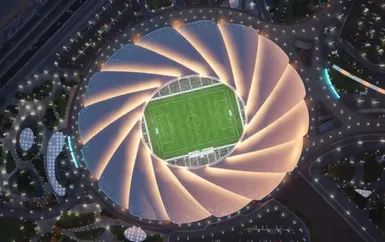
The stadium’s aesthetic pays homage to the coastal heritage of the Eastern Province(Saudi Arabia's largest province, stretching along the Arabian Gulf coast). Its sweeping exterior is inspired by the graceful rotation of waves—a natural marine phenomenon known locally as dawwama—expressed through elegant, overlapping translucent sails.

These architectural sails curve fluidly around the venue, allowing diffused natural daylight to wash over the concourses while deflecting intense solar heat. To maximize airflow and reduce the building footprint, designers engineered an elliptical seating bowl that draws cooling gulf breezes naturally through the stands.
Inside, the stadium features an ultra-modern displacement cooling network powered by tens of thousands of under-seat air diffusers. This engineering feat delivers crisp, low-velocity conditioned air directly around spectators without acoustic disruption or energy waste.
How Did the Construction Milestones Progress So Fast?
Constructing a 47,000-seat sports arena on an accelerated delivery timeline demands industrial efficiency at every turn. Following groundbreaking in mid-2024 by the joint venture of BESIX and ALBAWANI, the project moved from structural foundation to vertical erection in record time.
The progress achieved across critical project phases highlights the sheer scale of the undertaking:
- Earthworks & Ground Stabilization: Contractors cleared and graded more than 800,000 square meters of coastal terrain to build a rock-solid foundation.
- Precision Deep Excavations & Heavy Lifting: Heavy-duty excavators for rent broke through tough bedrock layers and dredged drainage channels, while mobile and tower cranes provided critical lifting support to construct deep sub-tier utility tunnels

- Rapid Structural Erection: Over 11,000 site personnel completed the reinforced concrete lower bowl and primary raker beams ahead of schedule.
- Roof Canopy Integration: Crews successfully placed custom-engineered, standing-seam metal canopies capable of resisting extreme coastal wind loads while shading spectator seats.
Which Heavy Machinery Fleets Drive Arena Earthworks?
Massive stadium footprints require specialized heavy equipment to handle millions of cubic meters of earth, rock, and aggregate. Reliable earthmoving machinery forms the literal backbone of stadium infrastructure.
During the initial grading stages, securing a robust bulldozer for rent ensures bulk sand, fill, and sub-base layers are leveled to exact civil engineering tolerances. Working in close tandem, modern dumper units and articulated haulers shift high volumes of cut materials across expansive perimeter roads without bottlenecking hauling corridors.

When preparing utility trenches, water retention reservoirs, and retention basins, contractors rely on specialized long reach excavator for rent packages. These extended-boom diggers clear deep slopes, shoreline gradients, and tricky utility ditches where standard equipment cannot safely reach.
Working directly alongside earthmovers, high-capacity mobile and crawler cranes drive deep-foundation activities, lowering massive piling cages, trench boxes, and underground culvert sections directly into newly cut ground before backfilling begins
Learn more about the essential role of heavy machinery in building sports stadiums through our previous blog.
How Do Contractors Handle Heavy Materials Across Expansive Sites?
A stadium site is an intense logistics hub requiring seamless material handling from staging areas directly to the installation face. Heavy precast steps, structural rebar cages, and MEP modules must move quickly and securely.

To maintain efficient logistics across the 800,000-square-meter footprint, site teams rely on distinct heavy-lifting assets:
- High-Capacity Loaders: Bringing a durable wheel loader for rent onto the site streamlines the transport of aggregates, sub-base gravel, and general backfill materials.
- Rough-Terrain Forklifts: Utilizing a heavy-duty 10 ton forklift allows staging yards to offload flatbed delivery trailers carrying structural steel plates, transformers, and palletized stone cladding.
- Aerial Work Platforms: Securing an articulated or telescopic boom lift for rent provides mechanical and electrical technicians with safe, flexible access to install facade sails and high-bay lighting trusses.
Deploying versatile lifting gear prevents costly crane downtime by handling secondary lifts independently across laydown yards.
You can read more about the World Cup 2026 stadium construction and King Fahd Stadium for FIFA 2034 in our previous blogs.
What Technologies Ensure Site Safety on Mega Sports Venues?
Building Aramco Stadium has surpassed over 10 million safe working hours despite high ambient temperatures and complex overhead structural lifts. This safety performance stems from cutting-edge jobsite intelligence.

Contractors deployed an AI-driven Smart Safety Command Center equipped with 360-degree high-definition site cameras and continuous drone inspections. Real-time thermal sensors monitor personnel hydration and heat exposure during warm shifts, alerting supervisors to schedule mandatory rotation breaks.

Furthermore, the site implemented an integrated crane collision-prevention radar network. This regional-first technology allows tower cranes and mobile crawler rigs to communicate automatically, cutting power before boom radii intersect.
Why Partner with Al Marwan for Your Next Megaproject?
Executing ambitious sports venues, urban developments, and transport networks across the GCC demands a machine fleet you can depend on daily. With over 48 years of regional contracting support and a fleet exceeding 3,500 machines, Al Marwan Heavy Machinery is built to power the Middle East's most challenging jobsites.
Whether you need high-capacity earthmovers, specialized long-reach booms engineered in-house, or certified equipment operators for heavy machinery rental deals backed by on-site mobile workshops, Al Marwan delivers end-to-end reliability. Explore our wide inventory of heavy equipment for rent or sale today at Al Marwan Machinery to keep your milestones on schedule
Frequently Asked Questions (FAQ)
What is the seating capacity of Aramco Stadium?
Aramco Stadium features a gross capacity of 47,000 seats configured for top-tier international football matches. It can expand up to 55,000 seats for major music concerts and cultural entertainment events.
Where is Aramco Stadium located?
The stadium is located in Sports City along King Saud bin Abdulaziz Road in northern Al Khobar, within Saudi Arabia’s Eastern Province.
Which major sports tournaments will be held at Aramco Stadium?
The venue is scheduled to host key group and knockout fixtures during the 2027 AFC Asian Cup and is designated as an official tournament venue for the FIFA World Cup 2034.
What heavy machinery is essential for stadium earthworks?
Stadium projects require excavators, wheel loaders, and bulldozers for earthmoving, paired with articulated dumpers for hauling. Vertical material placement and facade installations require tower cranes and mobile crawler cranes.
LEARN FROM OUR INDUSTRY EXPERTS
Latest news & updates
Inside Aramco Stadium: What Powers This 47,000-Seat Arena?
Sharjah Announces New Women-Only Tower in Kalba as Construction Projects Expand
Sharjah has announced another landmark development in Kalba, with a new women-only observation tower...
History Time: How Caterpillar Got Its Name?
When you visit an Al Marwan site, you’ll see massive machines bearing one of the most iconic names i...
Forklift Mast Height and Mast Types Explained
A forklift may have enough lifting capacity for a load, but that does not necessarily mean it can pl...

Al Marwan Hosts Kobelco Executives at Sharjah Headquarters
On October 23, 2026, Al Marwan Machinery was honored to host a high-profile delegation of guest...
