


A forklift may have enough lifting capacity for a load, but that does not necessarily mean it can pl...
Forklift Mast Height and Mast Types Explained
Nov 05 2026
By

A forklift may have enough lifting capacity for a load, but that does not necessarily mean it can place the load at the required height. The mast determines how high the forks can travel, whether the machine can operate beneath low ceilings, and how effectively it can stack materials inside warehouses, factories, ports, and construction yards.
This makes mast selection just as important as choosing between a 3 ton forklift, 5 ton forklift, or 10 ton forklift. A mast that is too short limits productivity, while one with excessive height may increase the machine’s closed height, affect visibility, and add unnecessary weight and cost.
Before comparing the main mast types, operators and procurement teams should understand the measurements used in forklift specifications.

What Is a Forklift Mast?
The mast is the vertical assembly at the front of a forklift that raises, lowers, and supports the forks and load. It normally consists of nested steel rails, hydraulic cylinders, chains, rollers, and a fork carriage.
Most conventional forklifts are offered with maximum lift heights between approximately 3 and 7 metres, although specialised warehouse reach trucks can exceed 10 metres. Al Marwan’s current forklift range includes machines with maximum reaches within the 3-to-7-metre range.
The required mast depends on the highest rack position, ceiling height, doorway clearance, load dimensions, operating surface, and whether the forklift must lift inside a container or another restricted space.
The choice should also reflect how materials move through the facility. Our warehouse material handling equipment guide explains how forklifts, pallet trucks, stackers, and other machines can be coordinated to improve warehouse flow.
Important Forklift Mast Height Measurements
“Mast height” can refer to several different measurements. Confusing them can result in ordering a forklift that reaches the rack but cannot pass through the warehouse door.
Maximum Fork Height
Maximum fork height is the highest point the fork surface can reach when the mast is fully extended. The required height should normally be slightly above the highest pallet position so the operator can lift the pallet clear of the rack beam.
For example, a rack beam positioned at 4.5 metres may require a maximum fork height of approximately 4.7 to 5 metres, depending on the pallet and racking design.
Lowered Mast Height
Also called the closed or collapsed height, this is the height of the mast when fully lowered. It determines whether the forklift can pass through doors, containers, trailers, mezzanines, and other low-clearance areas.
A forklift with a 5-metre lift height may have a lowered mast height of around 2.2 to 2.5 metres when fitted with a three-stage mast, although the exact dimensions vary by model.
Overall Raised Height
Overall raised height is the highest point of the forklift when the mast is fully extended. It includes the extended mast and, in many cases, the load backrest.
This measurement is often higher than the maximum fork height. OSHA advises operators to consider overall raised height when checking whether sufficient overhead clearance is available at the highest stacking position.
Free Lift
Free lift is the distance the forks can rise before the mast itself begins to extend.
This is especially important when working inside shipping containers, enclosed trailers, low-ceiling warehouses, and areas beneath pipes or structural beams. A full free-lift mast allows the operator to raise a pallet while keeping the forklift’s overall height nearly unchanged during the first part of the lift.

The Four Main Forklift Mast Types
Forklift masts are generally divided into four categories: simplex, duplex, triplex, and quad.
1. Simplex Mast: Single-Stage Mast
A simplex mast has one fixed rail section and offers limited extension. It is the simplest mast design and usually provides good forward visibility because it has fewer rails, chains, and cylinders in the operator’s line of sight.
Simplex masts are suitable for:
- Ground-level material movement
- Low stacking applications
- Outdoor yards
- Loading platforms without overhead restrictions
- Operations where visibility matters more than maximum lift height

They are less suitable for high warehouse racking because their lift height is relatively limited and their lowered height can be close to their maximum lift height.
A heavy-duty 10 ton forklift used to transport steel, concrete products, pipes, or industrial components may use a simpler mast when loads are mainly moved horizontally rather than stacked at significant heights.
2. Duplex Mast: Two-Stage Mast
A duplex mast uses two rail sections. The inner mast extends upward from the outer mast, allowing the forks to reach higher while maintaining a more manageable lowered height.
Duplex masts are widely used for:
- General warehousing
- Manufacturing facilities
- Outdoor material yards
- Loading and unloading trucks
- Medium-height stacking
Full free-lift versions are available for indoor applications. Depending on the mast configuration, a duplex mast may offer lift heights of approximately 3 to 4.5 metres.
A SOCMA HNF-30 forklift, representing the popular 3 ton forklift class, can support everyday pallet movement, warehouse operations, manufacturing, and general industrial handling. When configured with an appropriate duplex mast, it can provide a practical balance between visibility, lift height, and overall machine dimensions. Al Marwan also highlights the HNF-30 as a compact diesel forklift for construction and material-handling applications.
3. Triplex Mast: Three-Stage Mast
A triplex mast has three nested rail sections. It delivers a greater lift height while maintaining a relatively low collapsed height, making it one of the most versatile and commonly selected configurations.
Triplex masts are ideal for:
- High warehouse racking
- Distribution centres
- Cold-storage facilities
- Container loading
- Operations with low doorways and high stacking positions
- Sites requiring full free lift
A three-stage mast may allow a forklift to reach 4.5, 5, 6 metres, or more while still passing through a doorway around 2.2 metres high, depending on the model.
This configuration can be useful for all terrain forklifts that move heavier pallets through restricted entrances before stacking them at higher levels. However, buyers should check the residual capacity rather than relying only on the forklift’s nominal rating.
A forklift rated for five tonnes at a low lift height may handle less when the mast is fully raised, an attachment is installed, or the load centre moves farther forward.
4. Quad Mast: Four-Stage Mast
A quad mast uses four rail sections to achieve high lift heights from a compact lowered profile. It is designed for specialised operations where very high storage positions must be reached despite restricted door or ceiling clearances elsewhere in the facility.
Typical applications include:
- High-density warehouses
- Specialist storage facilities
- Narrow-aisle operations
- Facilities combining low entrances with high racking
Quad masts provide excellent height-to-collapsed-height performance, but they are more complex and can affect forward visibility because of the additional rails, chains, and hydraulic components. They may also require more inspection and maintenance than simpler mast designs.

Mast Height and Forklift Capacity
Maximum lift height should never be considered separately from load capacity. The higher a load is raised, the greater its effect on forklift stability.
Capacity is also calculated at a specified load centre. OSHA gives the example of a forklift rated for 5,000 lb, or approximately 2,268 kg, at a 24-inch load centre and a defined maximum height. Moving the load centre farther forward changes the load moment and can reduce the safe lifting capacity.
Always check the data plate for the exact mast, attachment, lift height, and load-centre configuration. Never assume that a 10 ton forklift can safely lift ten tonnes to every available height.
For more operating guidance, read our forklift safety and maintenance guide, which covers mast inspections, daily checks, load control, and preventive maintenance.
SOCMA Forklifts for Different Lifting Requirements
SOCMA manufactures diesel, electric, rough-terrain, and heavy-duty material-handling equipment for industrial, logistics, construction, mining, and port applications. Al Marwan offers SOCMA forklifts and related equipment with different capacities and configurations, supported by technical consultation and after-sales services.
Examples include:
- SOCMA HNF-30: A compact 3-ton diesel forklift for warehouses, industrial facilities, and general site handling.
- SOCMA HNF-250: A heavy-duty 25-ton forklift suited to steel, precast materials, ports, and industrial loads.
- SOCMA HNF-350: A 35-ton forklift designed for demanding heavy-lifting operations.
- SOCMA HNF-500: A 50-ton diesel forklift for major industrial, infrastructure, and port applications.
Customers comparing a forklift for rent with a forklift for sale should evaluate utilisation hours, project duration, required mast configuration, maintenance responsibilities, and future lifting needs.
The forklift price is influenced by capacity, power source, mast type, maximum lift height, attachments, tyres, cabin specification, and safety technology. Therefore, comparing the forklift price in UAE requires more than checking tonnage alone.
Businesses searching for a forklift for sale in Sharjah can explore Al Marwan Machinery’s range of SOCMA material-handling equipment and receive support in matching the mast to their operational clearances and loads. Buyers can also review Al Marwan’s Complete List of Forklift Brands and Manufacturers for a broader view of the global forklift market.

Frequently Asked Questions
What is the most common forklift mast type?
The triplex mast is one of the most versatile options because it combines a relatively low collapsed height with greater lift height and can provide full free lift.
How much mast height does my forklift need?
Choose a maximum fork height slightly above the highest pallet position. Also confirm the lowered and fully raised mast heights against every doorway, ceiling, pipe, and structural beam.
Does a taller mast reduce forklift capacity?
It can reduce residual capacity, particularly at maximum extension. The exact safe capacity must be taken from the forklift data plate for the specified mast, attachment, and load centre.
What mast is best for loading containers?
A duplex or triplex full free-lift mast is generally preferred because the forks can rise inside the container without immediately increasing the mast’s overall height.
LEARN FROM OUR INDUSTRY EXPERTS
Latest news & updates
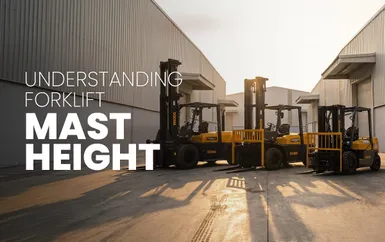
Forklift Mast Height and Mast Types Explained

Al Marwan Hosts Kobelco Executives at Sharjah Headquarters
On October 23, 2026, Al Marwan Machinery was honored to host a high-profile delegation of guest...
Small Wheel Loader or Skid Steer? Choosing the Right Machine for Tight Sites
Space can quickly become one of the biggest challenges on a construction site. Residential developme...
Top 8 Strategies to Prevent Accidents on a Construction Site
Every heavy construction site is a high-powered orchestra of roaring engines, multi-ton steel, and p...
How to Prevent Excavator Overheating on Hot UAE Job Sites
An excavator working through a UAE summer must manage more than the heat generated by its engine and...
