


A 10 ton forklift sounds straightforward: if the load weighs 10 tonnes, the forklift should be able ...
Why a 10-Ton Forklift Cannot Always Lift 10 Tons
Nov 26 2026
By

A 10 ton forklift sounds straightforward: if the load weighs 10 tonnes, the forklift should be able to lift it.
But that is not always true.
The “10-ton” rating is not a promise that the machine can safely handle every 10,000 kg load in every position. Forklift capacity depends on several factors, including the load center, load dimensions, lift height, mast configuration, attachments, and how the load is positioned on the forks.
That distinction becomes especially important in construction yards, steel facilities, warehouses, ports, and industrial sites where loads are often longer and less uniform than a standard pallet.

What Does “10-Ton Forklift” Actually Mean?
A forklift's rated capacity applies under specific conditions established by the manufacturer.
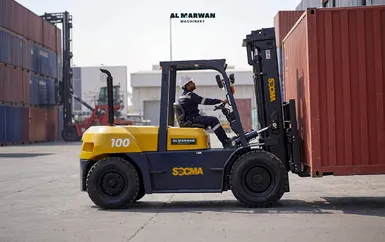
Take the SOCMA HNF100 as an example. SOCMA specifies a rated capacity of 10,000 kg at a 600 mm load center, with a standard lifting height of 3,000 mm.
That 600 mm figure is extremely important.
It means the center of gravity of the rated load must be positioned approximately 600 mm horizontally from the fork face under the specified configuration.
Move that center of gravity farther forward and the leverage acting against the forklift increases.
This is why two objects weighing exactly 10 tonnes can place very different demands on the same machine.
Load Center Changes Everything
Think of a forklift as a lever.
Moving a load’s center of gravity farther from the fork face increases its overturning moment, directly compromising the forklift's stability. As OSHA emphasizes, stability depends not just on weight, but on the size, shape, positioning, and distribution of the load.
Consider a simplified example using a forklift rated for:
10,000 kg at a 600 mm load center
The load moment at its rated condition is approximately:
10,000 kg × 600 mm = 6,000,000 kg-mm
Now imagine a much longer load with its center of gravity 800 mm from the fork face.
If we use the original rated load moment only as a simplified illustration:
6,000,000 ÷ 800 = 7,500 kg
At 1,000 mm:
6,000,000 ÷ 1,000 = 6,000 kg
So a load weighing 10 tonnes could exceed the machine's permitted capacity simply because its center of gravity is too far forward.
These calculations are useful for understanding the physics, but operators should never calculate their own safe capacity from this formula. The forklift's manufacturer-approved data plate and capacity chart determine the actual allowable load.
Learn more about forklift load center, and 500 mm is an industry standard.

Why Long Loads Are Particularly Important
Imagine lifting a compact 10-ton machine component versus a long steel section weighing the same amount.
The steel section may extend significantly beyond the forks. Its center of gravity can therefore sit farther away from the mast, increasing the load moment.
The same issue can occur when handling:
- pipes and steel sections;
- precast concrete components;
- timber;
- machinery;
- oversized pallets; and
- industrial components.
The load may weigh less than the forklift's headline rating and still be unsuitable for that particular configuration.
This principle applies to a 3 ton forklift and 5 ton forklift just as much as to heavy-capacity machines.
Lift Height Can Reduce Available Capacity
Another mistake is assuming rated capacity remains unchanged from ground level to maximum lift height.
Depending on the forklift and mast configuration, allowable capacity can decrease at higher lift heights because the combined center of gravity of the forklift and load rises.
That is why the capacity plate may specify different allowable loads for particular heights and load centers. Toyota, for example, explains that a forklift data plate provides the machine's rated capacity and operating limitations and should be checked before use.

Proper operation becomes even more important when lifting heavy loads at height. Operators should follow the correct inspection, handling, and stability procedures discussed in our guide to forklift safety and maintenance.
So if you need to place a heavy load onto a high rack, knowing only its weight is not enough.
You also need to know:
How much can this forklift lift at the required height and load center?
Attachments Can Derate the Forklift
Fork positioners, clamps, rotators, and other attachments can make a forklift far more versatile, but they can also affect capacity.
An attachment adds its own weight and may move the load farther forward.
OSHA specifically warns that attachments can increase the load center and states that operators must not exceed the rated capacity of the forklift-and-attachment combination.
A real example demonstrates the difference: OSHA presents a forklift rated for 5,000 lb at a 24-inch load center, while its listed capacity with a sideshifter is 4,500 lb under the specified configuration.
The attachment does not make the forklift weaker. It changes the geometry and available capacity.
Different attachments are designed for very different jobs, from fork positioners and side shifters to clamps and rotators. You can explore their applications in our guide to the top forklift attachments and how they are used.

Load Position Matters Too
Even a correctly sized load can become problematic if it is poorly positioned.
Loads should normally be placed as close to the fork face as practical, with their weight centered and properly supported. An off-center, unstable, or unevenly distributed load changes the machine's center of gravity.
This is particularly important on construction and industrial sites where operators may be handling irregular equipment rather than neatly packaged pallets.
Never assume:
10,000 kg forklift = any 10,000 kg object.
Instead, check:
load weight + load center + lift height + attachment + forklift capacity plate.
Choosing the Right Forklift for Your Site
Whether you are comparing a forklift for rent, planning forklift rental for a short project, or searching for a forklift for sale, capacity should be matched to the actual load rather than the number printed on the machine.
This also matters when comparing forklift price or forklift price in UAE. Selecting a smaller machine purely because it is cheaper can become expensive if it cannot safely handle your load dimensions or required lifting height.
Likewise, companies searching for a forklift for sale in Sharjah should provide the supplier with more than the maximum load weight. Load dimensions, center of gravity, operating environment, and required lift height can all influence machine selection.

SOCMA Forklifts from Al Marwan
Al Marwan Machinery supplies SOCMA material-handling equipment for demanding construction, logistics and industrial applications, including heavy-duty forklifts such as the SOCMA HNF100.
The HNF100 combines a 10,000 kg rated capacity, 600 mm rated load center, and 3,000 mm standard lifting height, making it suitable for heavy material-handling applications when operated within its approved capacity limits.
Need a 3 ton forklift, 5 ton forklift, or 10 ton forklift for your next operation?
Contact Al Marwan Machinery to discuss your load weight, dimensions, and required lifting height and find the right SOCMA forklift for your application.
FAQ
Can a 10 ton forklift always lift 10,000 kg?
No. A 10 ton forklift can lift 10,000 kg only under the rated conditions specified by the manufacturer, including the correct load center, mast configuration, lift height, and attachments. If the load center moves farther forward, the forklift's allowable capacity may decrease.
Does forklift capacity decrease with lift height?
It can. Depending on the mast and forklift configuration, the permitted capacity may be lower at greater lifting heights. Operators should always check the manufacturer's capacity plate or load chart rather than relying only on the forklift's headline capacity.
Do forklift attachments reduce lifting capacity?
They can. Attachments such as clamps, rotators, sideshifters, and fork positioners add weight and may move the load's center of gravity farther forward. This can reduce the forklift's net lifting capacity.
Should I choose a 5 ton forklift for a load weighing exactly 5 tons?
Not automatically. A 5 ton forklift may not safely handle every 5,000 kg load. Load dimensions, load center, lifting height, attachment type, and weight distribution must also be considered. The same principle applies when choosing a 3 ton forklift or 10-ton model.
How do I choose the right forklift for rent or purchase?
Before selecting a forklift for rent or forklift for sale, determine the maximum load weight, load dimensions, load center, required lifting height, attachments, and working conditions. Al Marwan can help match these requirements with suitable SOCMA forklift options.
LEARN FROM OUR INDUSTRY EXPERTS
Latest news & updates
Why a 10-Ton Forklift Cannot Always Lift 10 Tons
Kobelco Expands Demolition Lineup with SK650DLC-11 High Reach Excavator
Kobelco Construction Machinery U.S.A. (KCMU) has expanded its specialized demolition machinery portf...
Why Excavators Lose Digging Force: It Is Not Always the Hydraulic Pump
When an excavator starts to lose power, the hydraulic pump is usually the first component blamed. Th...
Caterpillar Launches New D11 XE Electric Drive Dozer for Mining
Caterpillar Inc. has officially introduced the flagship Cat D11 XE Electric Drive Dozer, markin...
Excavator Track Shoe Width: Narrow, Standard, or Wide?
When choosing an excavator, bucket capacity, operating weight, engine power, and digging depth usual...
